
Can an algorithm not only find fish in underwater video, but follow them and predict where they will go next? In this challenge, teams will work with real underwater video to develop methods for multi-object detection, tracking, and motion prediction, progressing from identifying individual fish in each frame to anticipating their future positions.

In this challenge, teams will work with real underwater video to develop methods for multi-object detection, tracking, and motion prediction. The competition progresses through three tasks:

  1. Detection: Identify and localize individual fish appearing in each video frame.
  2. Tracking: Associate detections across successive frames to maintain the identity of each fish as it moves through the scene.
  3. Prediction and Motion Modeling: Use observed trajectories to develop data-driven or dynamic models of fish motion and predict fish locations for up to 10 future frames.

No prior knowledge of fish biology or species identification is required. Fish will be treated as individual objects regardless of species. Detection provides the foundation for the challenge, while the main focus is on tracking individual fish over time and predicting their future locations.
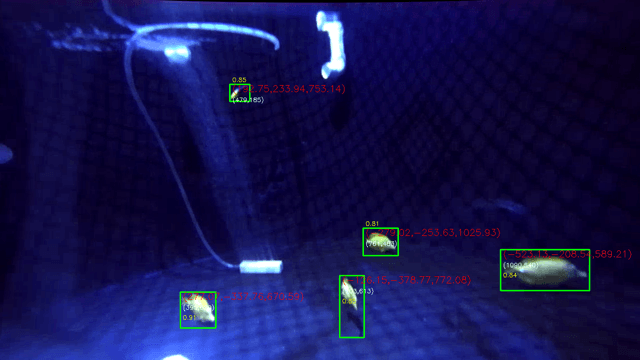
Figure 1: Example underwater perception output for the competition task. The vision pipeline detects multiple target objects in a low-light underwater scene and reports their image locations, confidence scores, and estimated 3D positions relative to the camera. Green bounding boxes indicate detected objects, while the overlaid annotations show the corresponding detection confidence and reconstructed spatial coordinates.  

This example illustrates robust target localization under challenging underwater illumination, contrast, and visibility conditions.

Registered teams will receive annotated training data, including ground-truth information, together with detailed technical specifications for the challenge at the beginning of October 2026.

At the start of the competition at CDC 2026, teams will receive new, previously unseen video sequences and will have time to test and refine their methods on these data. Final performance will be evaluated on unseen data, with detection, tracking, and prediction evaluated separately.

Teams will present their approaches and results at the final competition on December 18, 2026.


The competition is open to undergraduate and graduate students interested in control, machine learning, computer vision, robotics, marine applications, and related areas.

Teams may include students from different institutions and may consist of up to six student members and one team leader. The team leader may be a faculty member or postdoctoral researcher.

Participation is limited to six teams.

Because participation is limited to six teams, team leaders must contact Prof. Monique Chyba at chyba@hawaii.edu before registering to confirm that space is available. Once a team has been accepted, the team will receive the information needed to complete registration.

Each student must register individually for the competition.

  • Students already registered for CDC 2026 may participate in the Student Competition at no additional cost.
  • Students who are not registered for the full conference may register under the Student Competition Registration category for $125. This registration includes participation in the Student Competition and associated coffee breaks, but does not include paper uploads, the conference banquet, or receptions.

Registration deadline: October 15, 2026, or earlier if the six-team capacity is reached.

Beginning of October 2026

Training data, ground-truth information, and detailed technical specifications released

October 15, 2026

Registration Deadline

December 18, 2026

Final competition and presentation at CDC 2026, Honolulu, Hawai'i

For questions about the competition, contact cdcchallenge2026@gmail.com.

The competition is organized in collaboration with the Departments of Mathematics and Information and Computer Sciences at the University of Hawaiʻi at Mānoa and the Pacific Aquaculture and Coastal Resources Center (PACRC) at the University of Hawaiʻi at Hilo.